
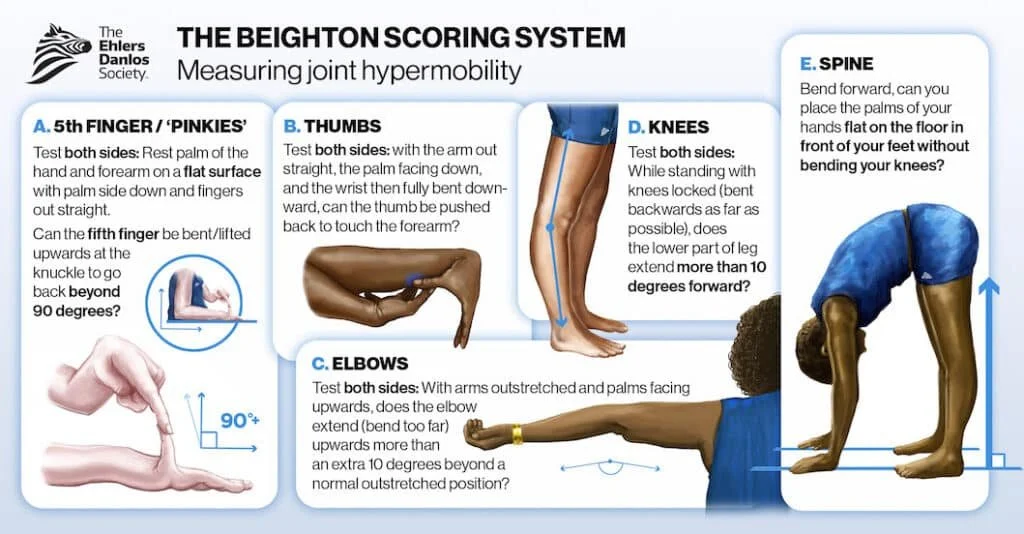
Ehlers-Danlos Syndrome, Chronic Pain, Fatigue, ADHD & Endometriosis: What Your Body Is Actually Telling You
Struggling with Ehlers-Danlos syndrome, chronic pain, fatigue, ADHD, or endometriosis? Learn how connective tissue, fascia, and the nervous system are connected and how targeted neuromuscular therapy can help.
This Isn’t a Trend. It’s Finally Being Seen.
Let’s clear something up.
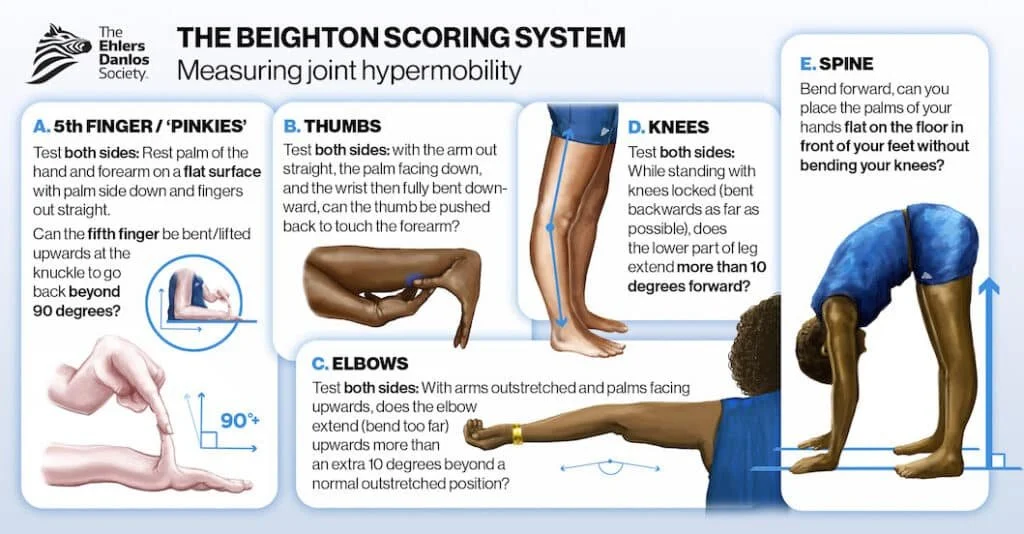
Ehlers-Danlos Syndrome (EDS), chronic fatigue, endometriosis, ADHD… this isn’t a coincidence. It’s not “everyone suddenly has it.”
It’s finally being recognized.
For years, people—especially women—have been told their pain was anxiety, hormones, or “just stress.” Now research is catching up, and it’s showing what many of us already knew:
These conditions are deeply connected.
What the Research Is Finally Showing
Newer studies are pulling back the curtain on what’s actually happening in the body.
Nearly 99% of people with hypermobile EDS report chronic pain, often affecting multiple areas of the body (SEDsConnective).
Research shows immune system involvement, chronic inflammation, and altered pain signaling are part of EDS, not just joint laxity (The Ehlers-Danlos Society Research on hEDS Biology).
There’s a growing link between EDS and neurodivergence like ADHD, including shared nervous system and proprioceptive differences (Chronic Pain Partners).
Studies suggest 6–23% of individuals with EDS also report endometriosis, with overlapping pain and inflammatory patterns (EDS Clinic).
Chronic pelvic pain is frequently reported in hypermobility conditions and is often overlooked or misdiagnosed (The Fibro Guy).
So no, you’re not “a mess of random diagnoses.”
You’re dealing with a system-wide pattern.
The Missing Link: Connective Tissue + Nervous System
Here’s where most providers miss the mark.
EDS is a connective tissue disorder, which means it affects multiple systems throughout the body (The Ehlers-Danlos Society):
Fascia (your body’s internal webbing)
Joint stability
Blood vessels
Organs
Nervous system communication
When that system is compromised, your body has to compensate.
That’s where you start to see:
Muscles constantly overworking just to stabilize joints
Chronic tightness that never fully releases
Fatigue that doesn’t match your activity level
Pain that moves or doesn’t make sense
Nervous system overload
This isn’t just muscular.
This is neurological and fascial.
Why You Feel So Damn Tired All the Time
Let’s talk about the fatigue.
It’s not just “being tired.”
When your body lacks structural stability, your muscles are doing the job your connective tissue should be doing.
That means:
Constant low-level contraction
Increased energy demand
Poor recovery
Nervous system overdrive
Add in chronic inflammation, which research is continuing to explore in EDS populations, and your body is essentially operating under constant physiological stress (The Ehlers-Danlos Society Research on hEDS Biology).
Where Endometriosis Fits Into This
This one gets overlooked a lot.
There is a growing body of research showing overlap between connective tissue disorders like EDS and endometriosis (EDS Clinic).
Connective tissue fragility can affect pelvic structures
Hormonal fluctuations impact both conditions
Mast cell and inflammatory responses are involved in both
Pelvic pain is often attributed to one condition while others are overlooked
The problem?
People get treated for one piece… and the rest is ignored.
ADHD, Pain, and the Nervous System
This is where it really clicks for a lot of people.
Emerging research shows a strong overlap between hypermobility and neurodivergence, including ADHD(Chronic Pain Partners).
Why?
Because:
Proprioception can be altered
The autonomic nervous system may be dysregulated
Sensory processing is often heightened
So now you’ve got:
A body that doesn’t feel stable
A brain that’s constantly trying to compensate
A nervous system that never fully downshifts
That’s not just ADHD.
That’s a body under constant stress.
My Approach as a NeuroFascial / Neuromuscular Therapist
This is where I come in—and why my approach is different.
I don’t diagnose medical conditions. If you suspect EDS or hypermobility spectrum disorders, it’s important to consult with a qualified healthcare provider, as there are multiple types and variations that require proper evaluation.
What I do is assess how your body is functioning.
I look at:
Fascial restrictions
Neurological compensation patterns
Joint instability contributions
Pain pathways, not just pain points
Because if you don’t address the why, you’ll keep cycling through temporary relief.
What Treatment Actually Looks Like
This isn’t a spa massage.
This is targeted, clinical work.
Sessions may include:
NeuroFascial reset techniques
Neuromuscular therapy
Targeted work to support joint stability
Nervous system regulation
The goal is not to “loosen everything.”
The goal is to create stability, efficiency, and reduce the overall demand on your system.
Why This Matters (Especially for Women)
A lot of women are walking around undiagnosed or misdiagnosed for years.
Delays in recognition and diagnosis are widely reported in connective tissue disorders (The Fibro Guy).
So when people say “everyone suddenly has EDS”…
No.
We’re just finally listening.
If This Sounds Like You
If you’ve been dealing with:
Chronic pain
Constant muscle tightness
Unexplained fatigue
Hypermobility or suspected connective tissue issues
Endometriosis or pelvic pain
ADHD or nervous system overwhelm
There is a reason your body feels the way it does.
And there is a way to work with it instead of constantly fighting it.
About Me
I’m a licensed neuromuscular and NeuroFascial therapist based in Huntersville, NC at Resilience Therapeutic Massage & Bodywork.
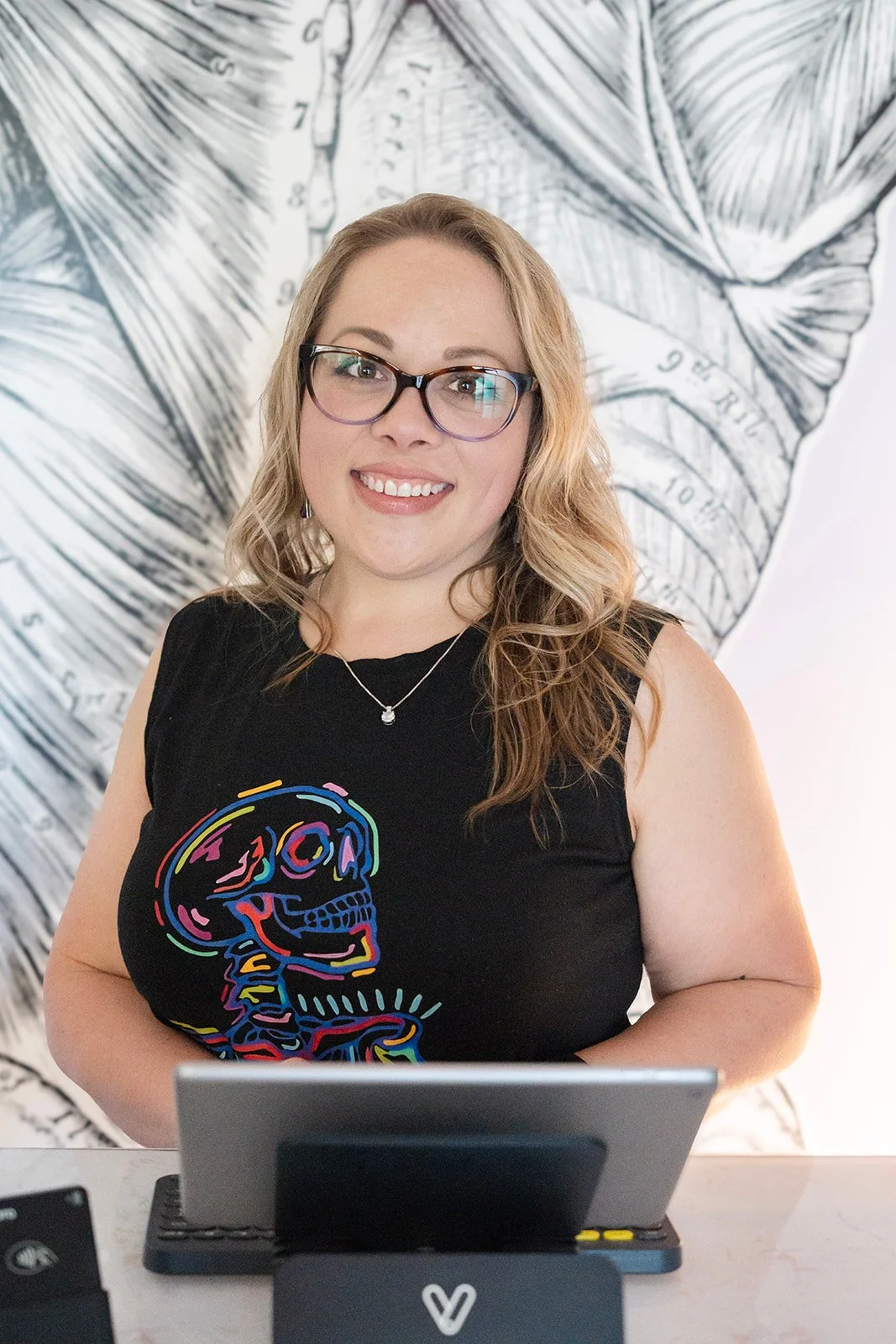
I specialize in working with hypermobility and EDS—and I also live with it.
I live it. I treat it. And I understand it.
I am currently booked out, but if you’re dealing with this and need guidance, you can reach out with questions or get on my schedule.
Because this isn’t something you just “push through.”
Serving Huntersville, Lake Norman & Charlotte, NC
Resilience Therapeutic Massage & Bodywork provides clinical neuromuscular therapy, NeuroFascial reset, and pain-focused bodywork for clients dealing with chronic pain, hypermobility, and complex conditions.
If you’re searching for:
Ehlers-Danlos syndrome support in Huntersville NC
Hypermobility treatment near Lake Norman
Chronic pain massage therapy in Charlotte
Neuromuscular therapy for fatigue and muscle pain
You’re in the right place.
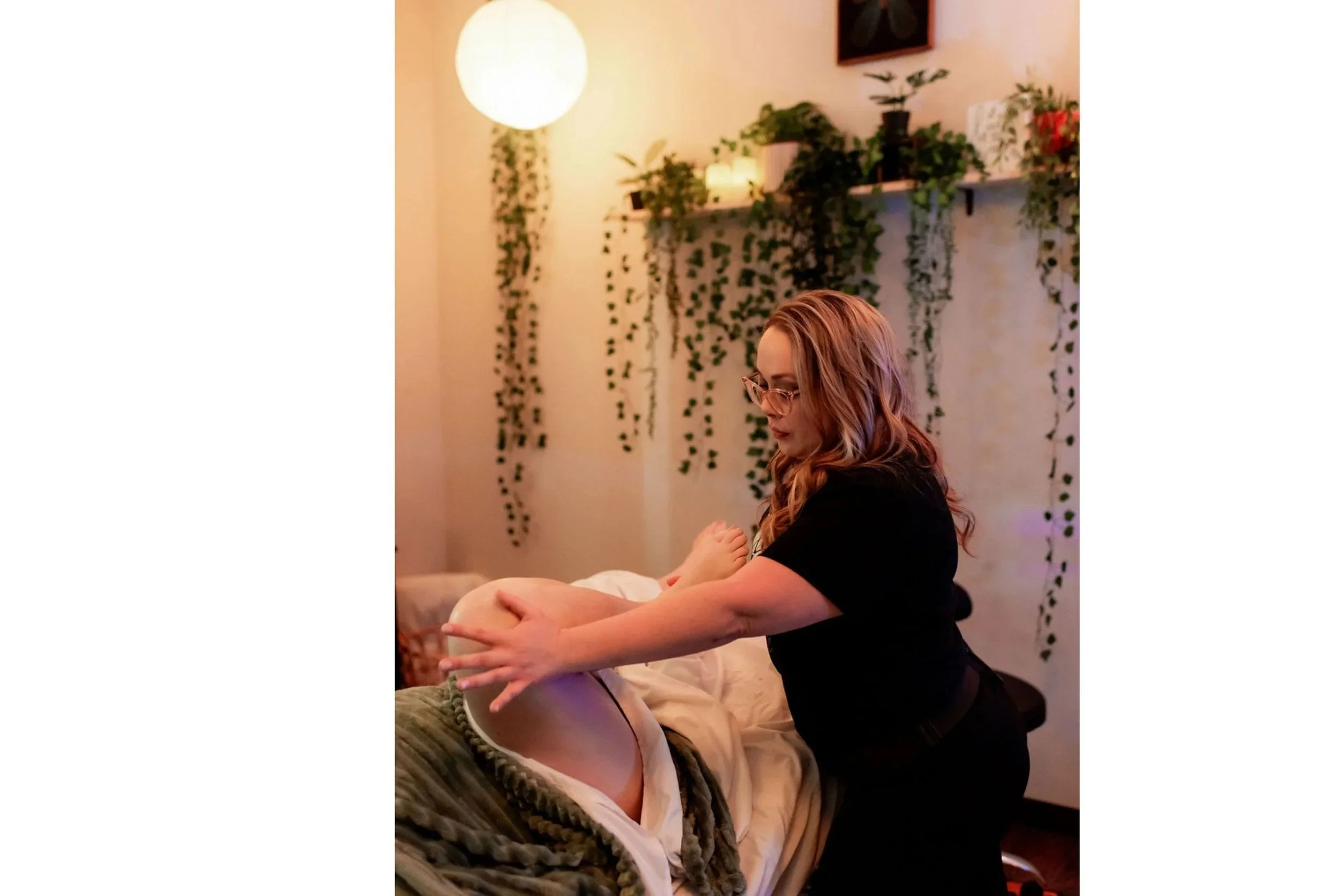
What Makes a Great Massage Therapist? Melanie Morris’ Journey & Approach in Huntersville, NC
What actually makes a massage therapist effective? It’s not just technique. Here’s the real story behind my approach to therapeutic massage in Huntersville, NC and how Resilience was built.
What makes a massage therapist actually good?
Not just relaxing for an hour, but someone who helps you feel real, lasting change in your body.
It’s not just technique.
It’s not just certifications.
And it’s definitely not about following whatever trend is popular in the industry right now.
It’s about experience, intuition, and understanding the person in front of you.
And honestly, a lot of that doesn’t come from a classroom.
It comes from life.
This is my story, how I got here, and why I approach my work the way I do.
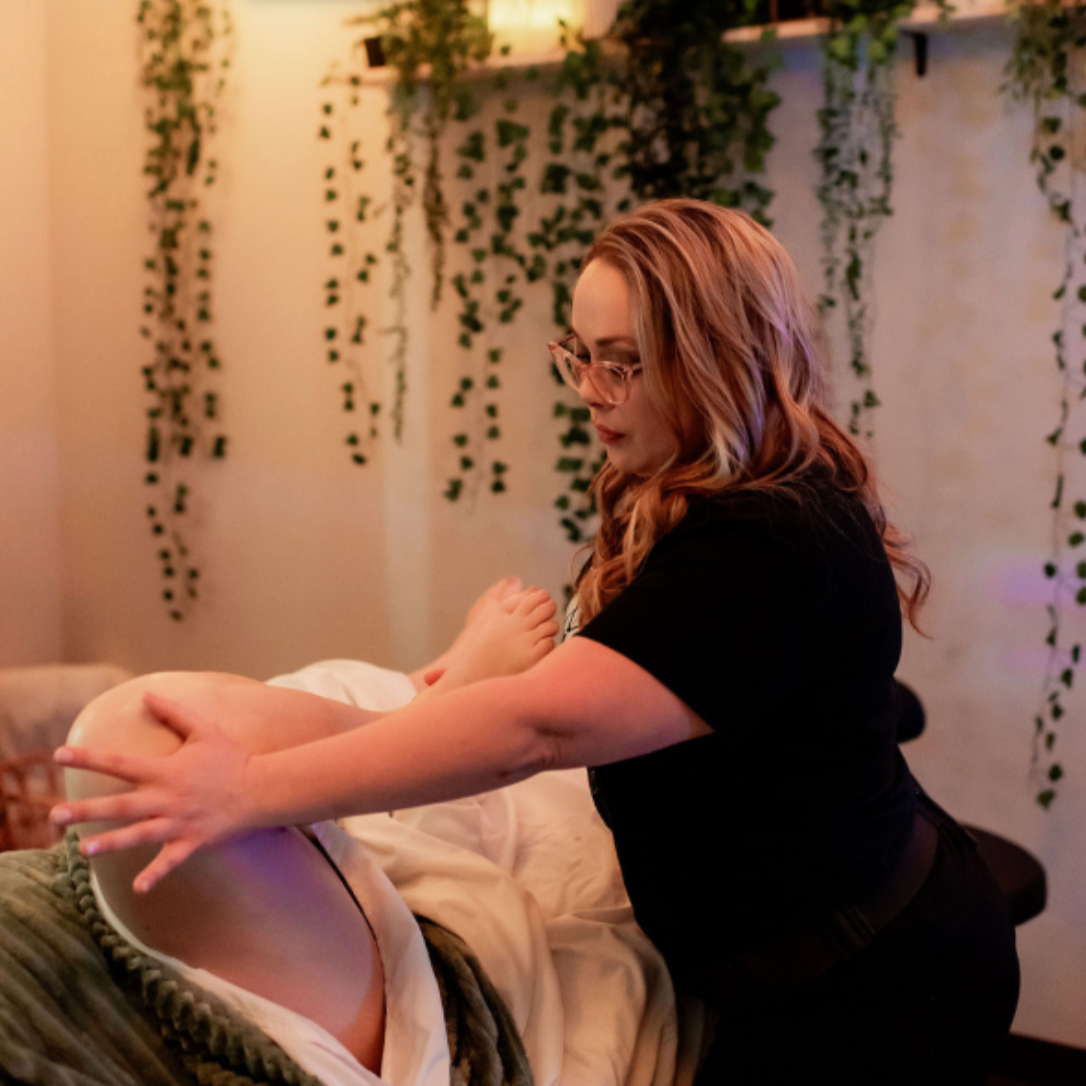
What actually makes a massage therapist effective? It’s not just technique. Here’s the real story behind my approach and how Resilience was built.
The Story Behind the Work
Detroit GRIT built me.
Motherhood refined me.
Intention in my work. Intuition in my hands. Rooted in Resilience.
I didn’t build this business during an easy season of life.
It was built while everything was shifting. I was going through a divorce, learning how to navigate single motherhood, and made the decision to leave a 13-year career in dentistry to start over at 30 as a massage therapist.
There were a lot of WTF moments where I had no idea if what I was doing was going to work… but I kept going anyway.
Massage therapy came into my life during that time, and pretty quickly I realized this wasn’t just about learning techniques or following a routine.
It was about people.
It was about understanding what someone is carrying, not just physically, but everything underneath that, too.
Because the body doesn’t lie.
Stress shows up.
Life shows up.
The things we push down or ignore… they show up.
And over time, I learned how to listen to that.
Not just with my ears, but with my hands.
That’s where my work comes from.
Not from chasing the newest technique or doing something because it’s trending in the industry.
I do what works.
I do what makes sense for the person in front of me.
Sometimes that looks different than what someone else would do, and that’s okay.
Because this work isn’t one-size-fits-all, and it shouldn’t be treated that way.
I started small, as most people do.
A handful of clients.
Shared spaces.
Some really awkward setups that made zero sense at the time.
But I showed up.
And I kept showing up.
And over time, people started to trust me.
They came back.
They referred their friends.
They felt a difference.
And that trust is what built everything.
But at some point, I realized this wasn’t meant to stop with me.
Resilience was never meant to be just me in a room.
It became something bigger.
A space for other practitioners who are good at what they do, but don’t always feel like they fit into the mold this industry tries to put them in.
A space where you don’t have to change who you are to be successful.
Where you don’t have to follow every trend just because someone says it’s the “right” way.
Where you can actually learn how to think for yourself, trust your work, and grow into the kind of therapist you want to be.
I don’t believe in forcing people into a box.
I believe in helping them figure out what works for them.
Some people would call that mentoring.
Some might not.
But I know that the practitioners who have come through here have taken something with them.
Something that helped shape how they work, how they think, and how they run their own businesses now.
And that’s the point.
Resilience isn’t just a place you come to work or get a massage.
It’s a place you grow.
As a client.
As a practitioner.
As a person trying to figure things out.
Because I’ve been there.
Starting over.
Second-guessing everything.
Trying to find your way in an industry that has a lot of opinions and not a lot of real guidance.
So what I’ve built here is simple.
A space where clients are cared for in a way that actually makes sense for them.
And a space where practitioners can grow without being judged or molded into something they’re not.
No fluff.
No forced formulas.
No “this is the only way.”
Just real work.
Because at the end of the day, this isn’t about doing what “looks” good.
It’s about doing what actually helps people.
And that’s what I’ll always stand behind.
If you’re in the Huntersville, NC area and looking for more than just a typical massage, this is exactly what we focus on at Resilience Therapeutic Massage & Bodywork.
Whether you’re dealing with chronic pain, limited movement, or just know something in your body isn’t right, we take a more intentional approach to help you understand what’s going on and what will actually help.
And if you’re a practitioner looking for a place to grow your skills and build your own path, Resilience was built for that, too.
You can learn more, book a session, or reach out directly through the site.

Infrared Sauna Benefits: More Than Just Sweat
What does an infrared sauna actually do? From pain relief to recovery, here’s how sauna sessions work and how to use them the right way.

Infrared saunas are everywhere right now.
But most people don’t actually know how to use them… or why they work.
At Resilience, we don’t use the sauna as a trend.
We use it as a tool.
What It Actually Does
An infrared sauna heats your body directly, not just the air around you.
That means:
• deeper heat
• better circulation
• a more effective sweat without extreme temperatures
Why People Use It
Most clients come in for one of three reasons:
Pain & tension
Heat helps relax tight muscles and improve movement.
Recovery
Great before or after bodywork or workouts.
Nervous system reset
It slows everything down. Your body gets a chance to breathe.
Let’s Talk About “Detox”
Yes, you sweat.
But this isn’t a magic fix.
Your body already knows how to detox. The sauna just supports that process.
How We Use It
This isn’t “sit and sweat and hope for the best.”
You can:
• use it before a massage to warm up tissues
• use it afterward to extend results
• or book it on its own when your body needs a reset
Simple. Intentional. Effective.
Self-Guided Infrared Sauna in Huntersville, NC
If you’re looking for an infrared sauna in Huntersville, NC that actually supports your body, not just relaxation, this is how we approach it at Resilience Therapeutic Massage & Bodywork.
No fluff.
No trends.
Just what works.
Book a self-guided infrared sauna session or pair it with a massage to get more out of your time.
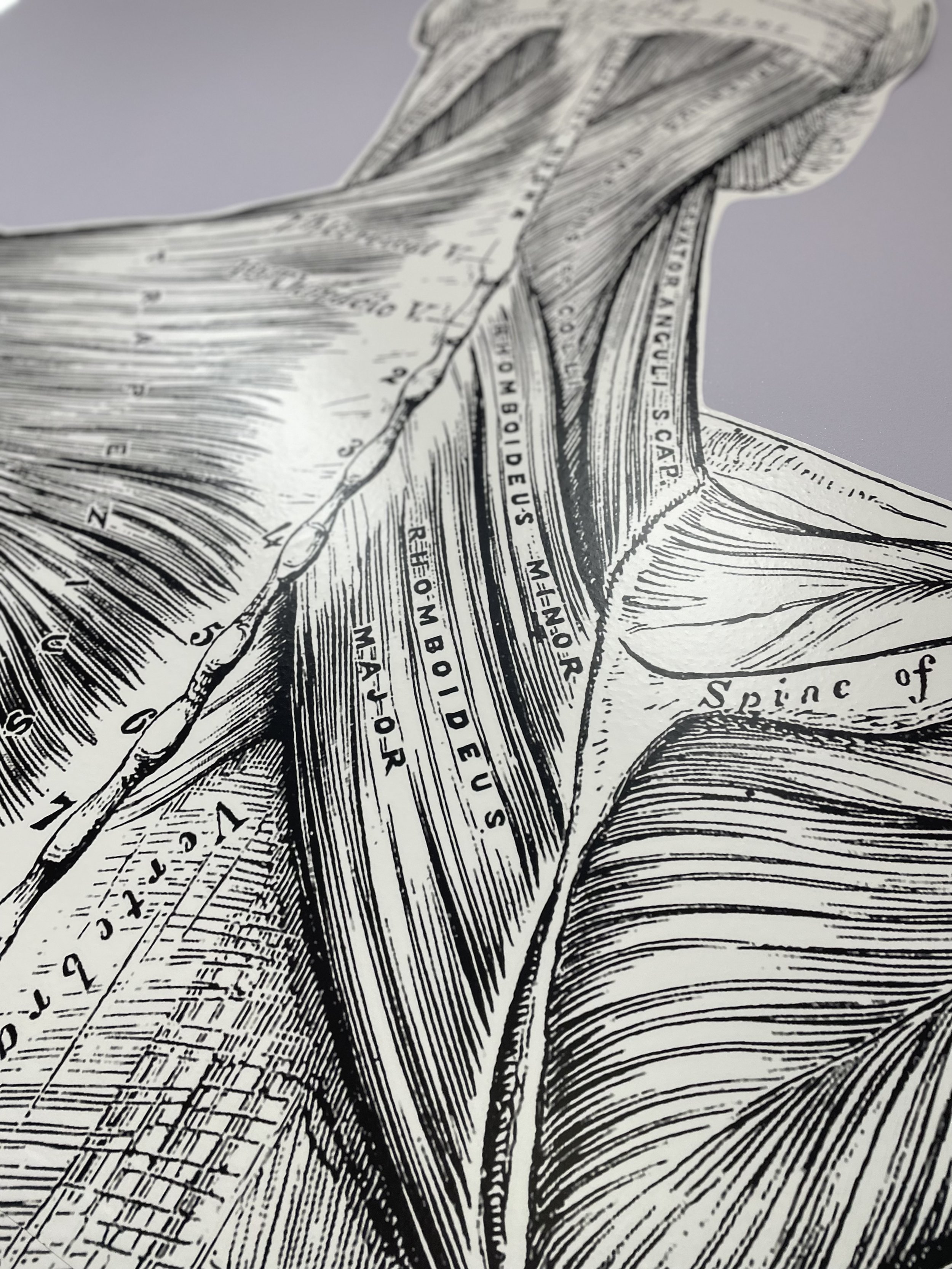
The Lesser Known Culprit: Exploring the Surprising Effects of Scalene Muscle Tension
Neck pain, shoulder tension, or tingling down your arm? The scalene muscles might be the hidden cause. Here’s what to know.
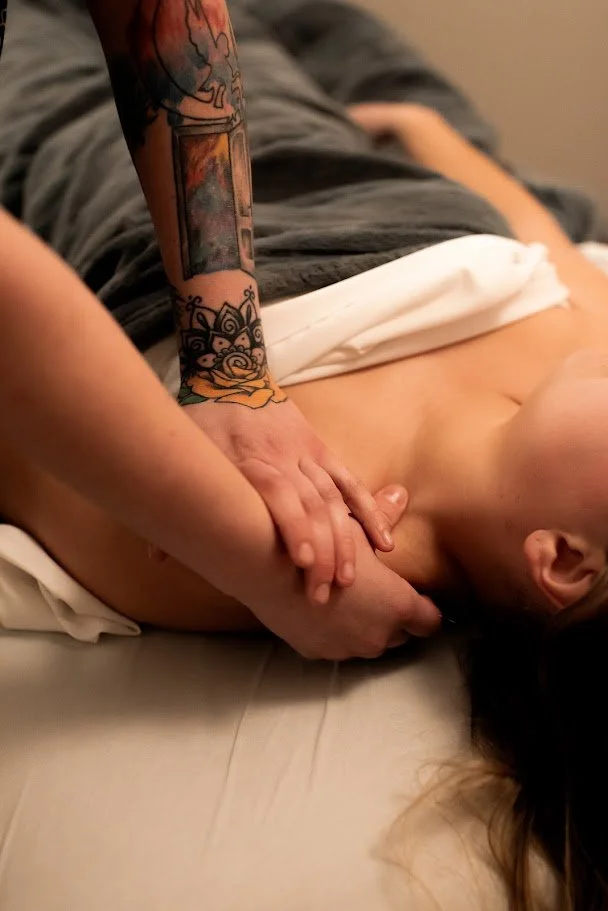
If you’ve ever had:
• neck tension that won’t go away
• pain that travels into your shoulder or arm
• tingling, numbness, or that “weird” nerve feeling
…it might not be what you think.
One of the most overlooked culprits?
Your scalene muscles.
What Are the Scalenes?
They’re a small group of muscles in the front and side of your neck.
You don’t think about them much… until they start causing problems.
And when they do, they can create symptoms that feel way bigger than where they actually are.
What Happens When They’re Tight?
When the scalenes get overworked or tight, they can compress nerves and blood vessels that travel through your neck.
That can lead to:
• neck and shoulder pain
• pain or tingling down the arm
• headaches
• tightness when turning your head
• even difficulty taking a deep breath
Yes… breathing.
These muscles actually assist with breathing, so when they’re tight, your body can feel restricted without you realizing why.
Why It Happens
This is where most people relate.
• poor posture (looking down at phones, sitting at desks)
• stress and tension
• overuse from workouts or daily activity
• holding your shoulders up without realizing it
Your body adapts… until it doesn’t.
Why It Gets Missed
A lot of people assume:
“It’s my shoulder.”
“It’s a pinched nerve.”
“It’s just tight muscles.”
And while those aren’t wrong, they’re not always the full picture.
If the scalenes are involved, you won’t get lasting relief unless they’re addressed.
How We Approach It
At Resilience, we don’t just chase symptoms.
We look at how everything connects.
That means:
• addressing the scalene muscles directly
• working into surrounding areas like the neck, chest, and shoulders
• improving movement and reducing pressure on the nerves
It’s not always the obvious spot that needs the most attention.
When to Pay Attention
If you’ve been dealing with:
• ongoing neck and shoulder tension
• arm discomfort or tingling
• limited range of motion
• that “nothing is really fixing it” feeling
…it might be time to look a little deeper.
Neck Pain & Bodywork in Huntersville, NC
If you’re in the Huntersville, NC area and dealing with symptoms like this, we take a more targeted approach at Resilience Therapeutic Massage & Bodywork.
This isn’t just about working where it hurts.
It’s about figuring out why it’s happening in the first place.
And then doing something that actually helps.
Book your tailored massage session
When Hip Imbalances Cause Numbness: How Corrective Bodywork Restores Mobility in Huntersville, NC
Hip pain, numbness down your leg, or feeling “off” in your posture? Here’s how corrective bodywork restores balance and mobility.
If you’ve been dealing with hip discomfort, numbness down the leg, or that constant “off” feeling in your posture, you’re not alone. At Resilience Therapeutic Massage & Bodywork in Huntersville, NC, we see clients every week who walk in frustrated, uncomfortable, and unsure why their body seems to be working against them.
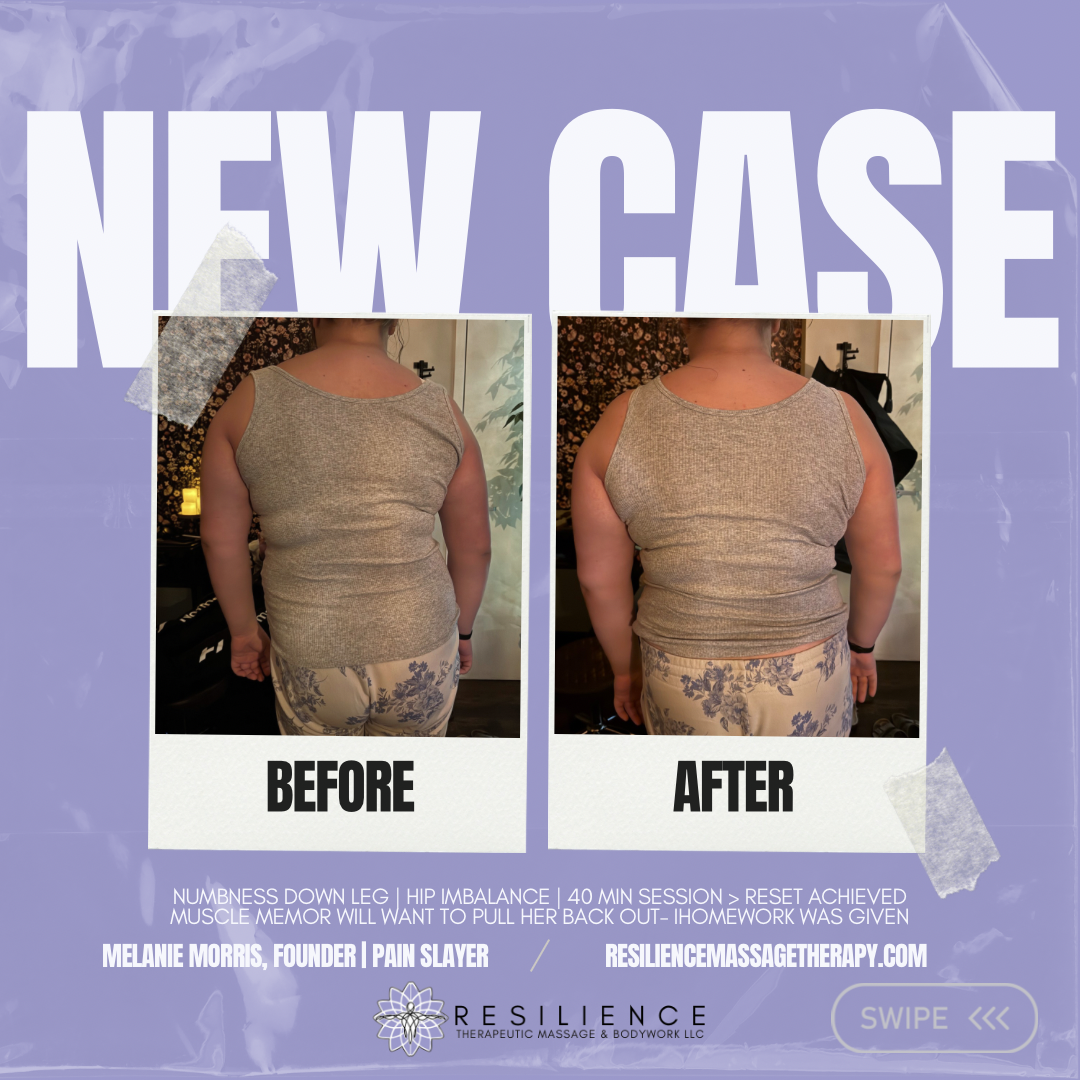
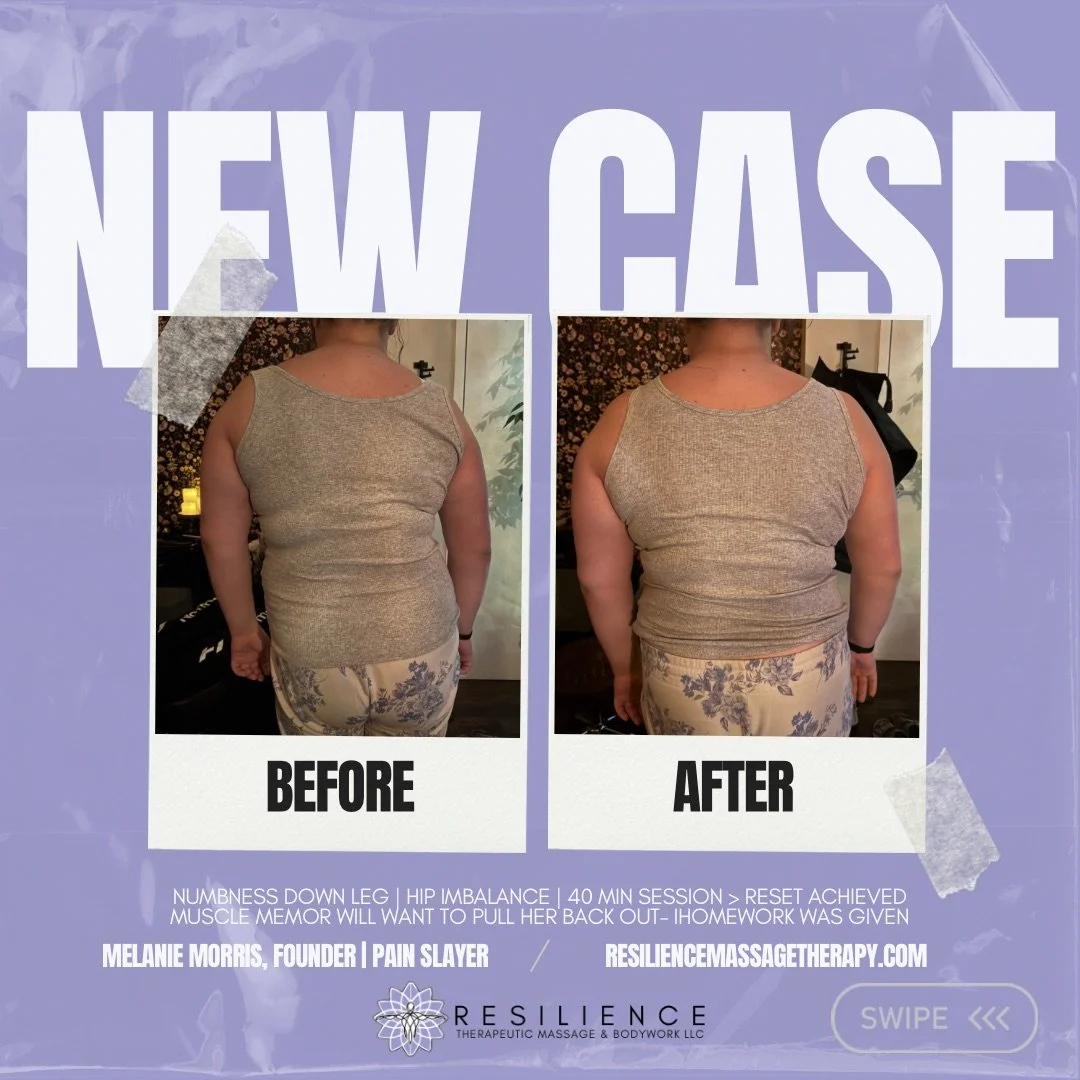
Recently, a client came in with numbness running down her leg, a “pinched nerve” sensation, and a posture shift she couldn’t control. What she didn’t realize was that her body had created a compensation pattern to protect the irritated area—leaving her with an uneven hip, a high shoulder, and even more discomfort.
In just 40 minutes, we were able to identify the dysfunctional pattern, release the restricted tissues, and reset her alignment. The changes were obvious in the before/after photos—and more importantly, she felt relief immediately.
Understanding Compensation Patterns: Why Your Body Shifts Without You Noticing
When pain, numbness, or nerve irritation shows up, the body will automatically shift weight, rotation, or posture to avoid triggering that discomfort.
In this client’s case:
Her left shoulder lifted higher than the right
Her torso leaned off-center
Her hip shifted and rotated to decompress the nerve
Her waist crease deepened on one side, indicating a full lateral shift
These small shifts add up fast, often causing:
Hip pain
Low-back tightness
Nerve tension
“Pinched nerve” sensations
Reduced mobility
A cycle of repeated flare-ups
Many clients think the issue starts where the pain is, but often the root cause is a dysfunctional pattern somewhere else.
How Corrective Bodywork Helps Restore Balance
At Resilience Therapeutic Massage & Bodywork, we specialize in corrective, results-driven bodywork—not cookie-cutter massage.
For this client, we used a customized combination of:
Rapid NeuroFascial Reset (RapidNFR)
Myofascial release targeting the hip and low back
Central nervous system down-regulation
Mobility restoration through guided movement
The result?
✔️ Hips leveled
✔️ Shoulders more symmetrical
✔️ Torso centered
✔️ Numbness relieved
✔️ A clearer, more functional movement pattern
✔️ Homework provided to keep the progress locked in
This wasn’t a “relaxation massage.”
It was a structural correction session designed to help the body work the way it’s supposed to.
Why People in Huntersville, Lake Norman & Charlotte Seek Us Out for Pain Relief
Our studio has become a go-to location in the Huntersville, Lake Norman (LKN), Cornelius, Mooresville, and greater Charlotte area for clients who are:
Struggling with hip pain
Experiencing numbness down the leg
Dealing with shoulder or pelvic imbalances
Feeling limited range of motion
Tired of temporary fixes that never address the root cause
Looking for real, lasting relief
nervous system regulation
We’re known for our corrective pain work, our individualized approach, and our ability to create noticeable change in one session—often where other avenues fall short.
Signs You Might Have the Same Compensation Pattern
You may be experiencing the same issue if you notice:
One shoulder sits higher
One hip feels “stuck” or rotated
You stand unevenly in photos
You feel numbness or tingling down one leg
Your body leans to one side without realizing it
Stretching doesn’t fix the problem
Chiropractic adjustments don’t “hold”
You feel relief temporarily, but the pattern comes back
These are classic signs the nervous system is guarding—and corrective bodywork can help.
Looking for Corrective Massage or Pain Relief in Huntersville, NC?
If you’re in the Huntersville, Lake Norman, Cornelius, Mooresville, Davidson, or Charlotte area and you’re dealing with hip pain, nerve pain, or posture imbalance, our team is ready to help you get results that last.
At Resilience Therapeutic Massage & Bodywork, we focus on:
Corrective bodywork
Pain relief
Posture improvement
Mobility restoration
Functional movement
Rapid NeuroFascial Reset
Lymphatic + recovery techniques
Evidence-informed therapeutic sessions
Our goal?
To help you move better, feel stronger, and stop letting pain run the show.
📍 Resilience Therapeutic Massage & Bodywork
Huntersville, NC — Lake Norman Region
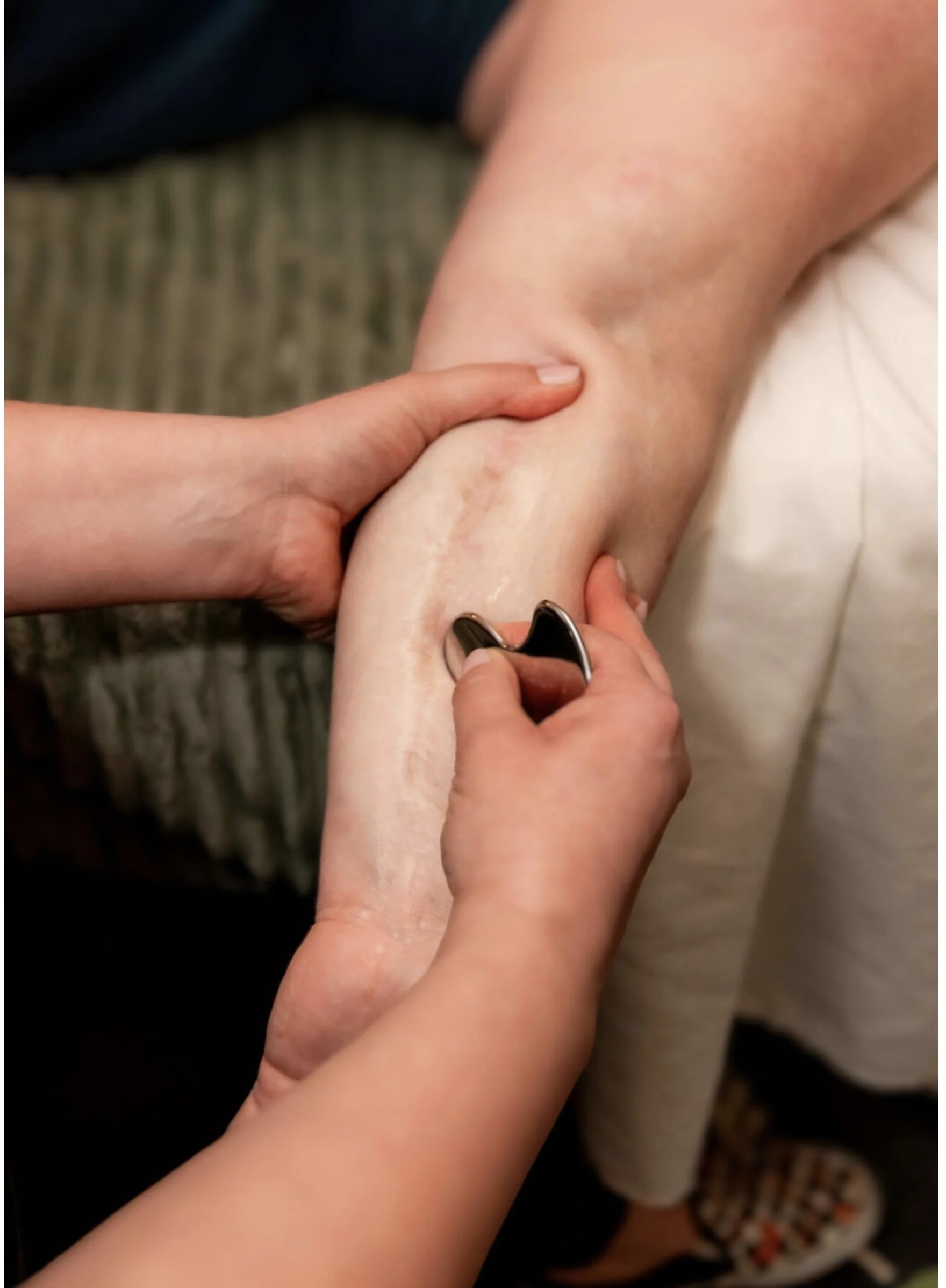
Unleashing the Power of Healing: Scar Tissue, Post-Surgery Recovery, and the Role of Massage Therapy
Scar tissue can limit movement and cause pain after surgery. Learn how massage therapy supports recovery and restores mobility.
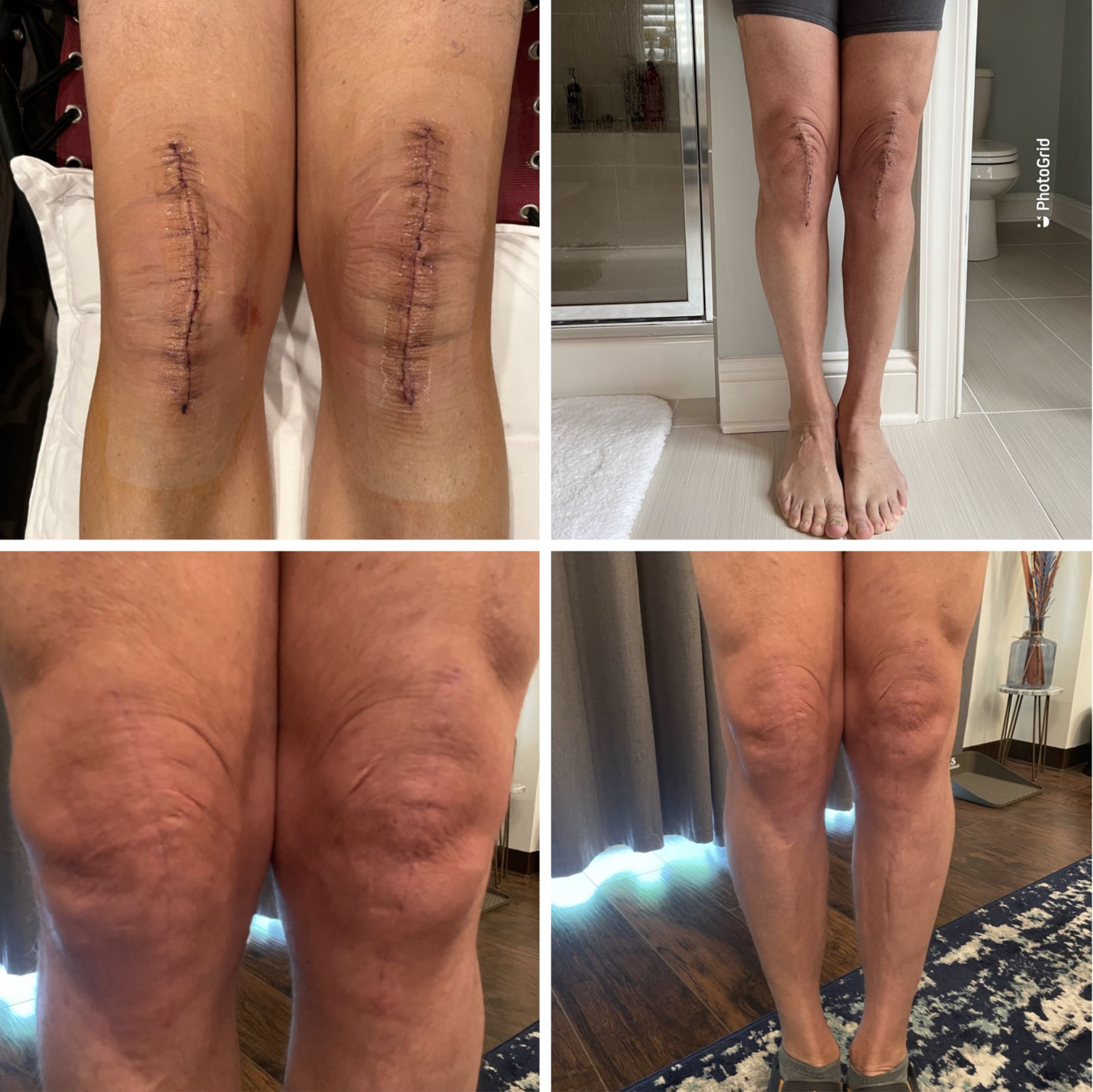
Unleashing the Power of Healing:
Scar Tissue, Post-Surgery Recovery, and Therapeutic Massage
Huntersville, NC
Surgery can change a lot in the body.
And while healing is happening, scar tissue forms as part of that process. That’s normal.
What most people aren’t told?
Scar tissue can also limit movement, create tension, and contribute to pain long after the surgery itself has healed.
Understanding Scar Tissue
Scar tissue forms to repair and protect.
But unlike healthy tissue, it doesn’t move or function the same way.
Over time, this can lead to:
• restricted mobility
• pulling or tightness in the area
• discomfort or lingering pain
• compensation patterns in other parts of the body
This is where many people get stuck in their recovery without realizing why.
Where Massage Therapy Comes In
Massage therapy can play a huge role in post-surgical recovery when done correctly and at the right time.
At Resilience, we approach scar tissue work with intention, not force.
The goal is to:
• improve tissue mobility
• reduce restriction
• support circulation
• help the body move more naturally again
What It Actually Helps With
Scar Tissue Mobility
Targeted techniques like myofascial release and gentle cross-fiber work help reduce adhesions and improve how the tissue moves.
Circulation & Healing
Better blood flow supports oxygen delivery and helps the body continue its healing process.
Pain Reduction
Releasing tension around the area can decrease discomfort and reduce sensitivity.
Movement & Function
As tissue becomes more mobile, the body can return to more natural movement patterns.
Nervous System Support
Recovery isn’t just physical. Massage helps calm the system and allows the body to shift out of protective patterns.
Timing Matters
Not all scar tissue work should happen right away.
Proper healing timelines and medical clearance are important.
This is why working with someone who understands post-surgical care makes a difference.
Post-Surgical Bodywork in Huntersville, NC
If you’re in the Huntersville, NC area and dealing with tightness, restriction, or discomfort after surgery, this is something we work with regularly at Resilience Therapeutic Massage & Bodywork.
This isn’t aggressive work.
It’s intentional, informed, and tailored to where your body is in the healing process.
The Goal
To help you restore movement, reduce discomfort, and feel more like yourself again.
Because healing shouldn’t stop once the incision closes.
Disclaimer
This information is for educational purposes only and is not a substitute for medical advice. Always consult with your physician or healthcare provider before beginning post-surgical bodywork or scar tissue treatment. Massage therapy should only be performed once you have been cleared for care.
If you’re unsure where to start, we’re always here to guide you in the right direction.